It came back inconclusive. The confidence intervals were wide enough that I would not defend any single number from it, and the follow-up I ran to fix that was worse. I was measuring the right thing badly.
Then a much simpler question. Can you just encode a JPEG in a thousand words? Not describe it. Encode it.
That turns out to be arithmetic, and I should have started there.
A thousand words of real descriptive English is 6,371 bytes of raw text. Compressed it is 2,644. I did not assume that number, I measured it on the seventy-five hundred words of description the first study had already produced. Gzip gets English down to about 2.6 bytes per word. At Shannon's estimate for the theoretical limit of English you would get to 874 bytes, but nothing achieves that, so 2,644 is the honest figure.
So the question becomes concrete. What image fits in 2,644 bytes?
I searched it properly rather than guessing, because there are two knobs and they trade off. For every candidate resolution, take the highest quality that still fits the budget, scale it back up, and score it against the original. The winner is the size that maximises fidelity, which is what people mean by the largest image that fits once you account for the fact that a big smeared picture is worse than a small clean one.
The answer, in AVIF, is about 470 by 370 pixels. In JPEG, closer to 300 by 240. If you spend your thousand words as uncompressed text instead, you get 742 by 588.
A thousand words is a thumbnail. That is the whole finding, and the proverb is a surprisingly good estimate.
What makes it interesting is putting that thumbnail next to the other thing a thousand words buys.
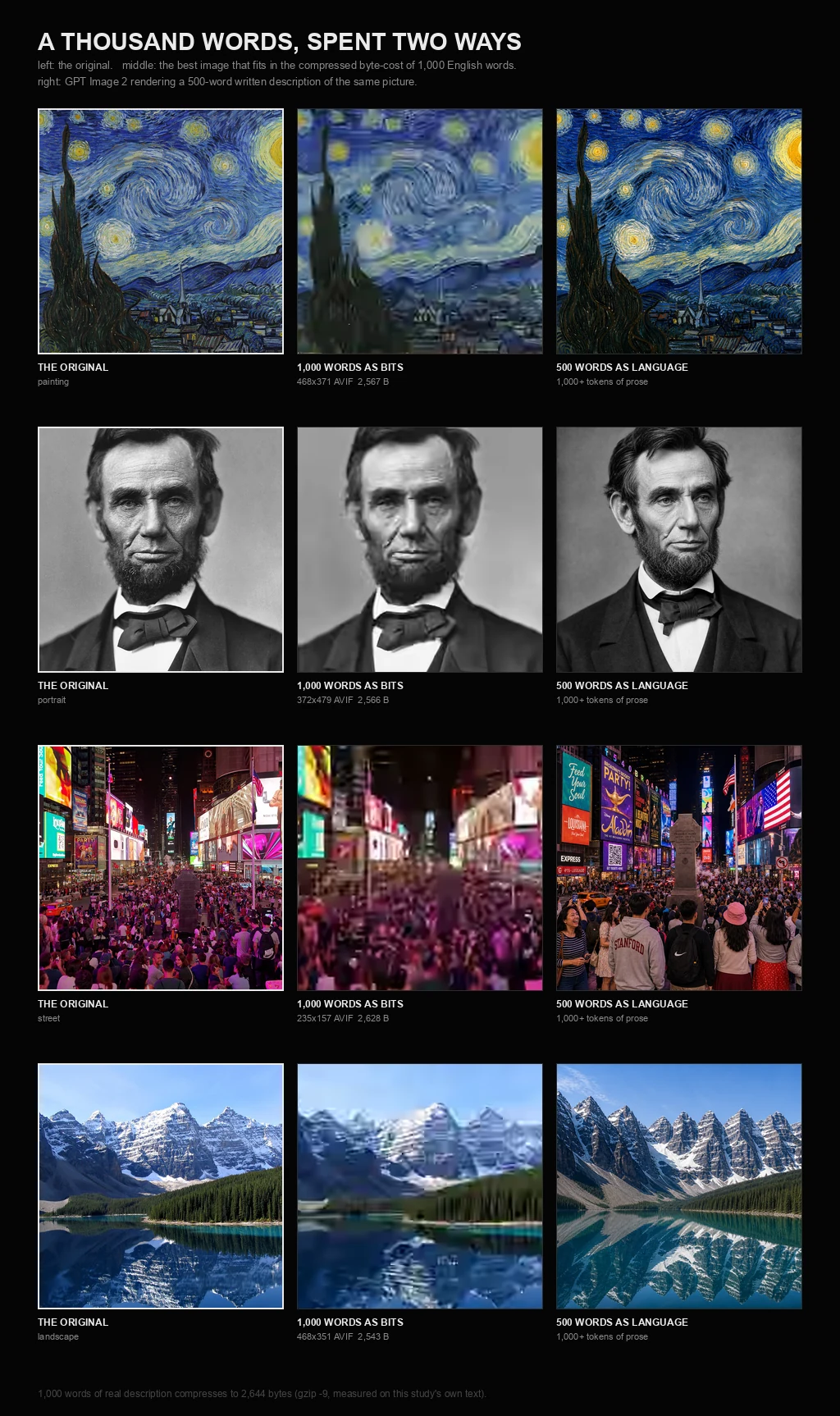 Left, the original. Middle, a thousand words spent as bits. Right, five hundred words spent as language, rendered by GPT Image 2. Tap to enlarge.
The middle column is soft and it is unmistakably the right picture. The Times Square thumbnail is blurry and it is that exact frame, same elevated vantage, same crowd, same billboards in the same places.
The right column is sharp and it is the wrong picture. The description was five hundred words and produced a gorgeous Times Square taken from street level, with a different crowd and invented signage. Lincoln becomes a different photograph of Lincoln. Moraine Lake becomes a different afternoon at Moraine Lake.
Spent as bits, a thousand words gets you that picture, softly. Spent as language, it gets you a picture, sharply.
The efficiency gap is larger than I expected. A thirty-two pixel thumbnail costs about 137 bytes once you strip the file container, which is fifty-two words. Measured on structural agreement with the original, that fifty-two word thumbnail scores 0.364. Five hundred words of careful description, rendered by a very good image model, scores 0.210.
Fifty-two words of pixels beat five hundred words of prose at being the same picture, and it is not close.
I want to be careful about what that measurement is. It asks whether this is the same picture, not whether it is a good one. The prose reconstructions are the most beautiful images in that grid and the least like their originals. And on the thing the thumbnail cannot do, the words win completely. You cannot read a single billboard at 235 by 157. The description tells you the sign says Text OR Drive, There Is No AND.
Which is the actual result. The two channels fail in opposite directions. Language loses the instance and keeps the meaning. Bits keep the instance and lose the meaning. Neither is a lossy version of the other, and asking how many words a picture is worth assumes they are the same currency.
The first study, for all its noise, showed the same thing from the other side. Naming a famous painting reproduced it almost exactly in ten words, because those words were not describing anything. They were pointing at something the model already held. For an unfamiliar picture with no name to invoke, ten words got you very little and every word after had to do real work.
So the honest reading of the proverb is that it is arithmetically close and directionally backwards. We say it to praise pictures for being rich. The measurement says a small picture is worth about a thousand words, and that language was never a compression format for images in the first place. It is an addressing scheme.
One number keeps this in proportion. Your phone takes photographs of about four megabytes. As literal bits, that is a million and a half words. A thousand words is seven hundredths of one percent of one photo off your camera roll.
The part I have not worked out is whether you can spend the budget across both. Fifty words on a thumbnail to fix the composition, nine hundred and fifty on language to fix the detail, and let a generator reconcile them. The failure modes are exactly complementary, which is usually a sign that a combination beats either. I do not have a clean way to test it yet, because that needs a model that conditions on an image properly rather than on a description of one.