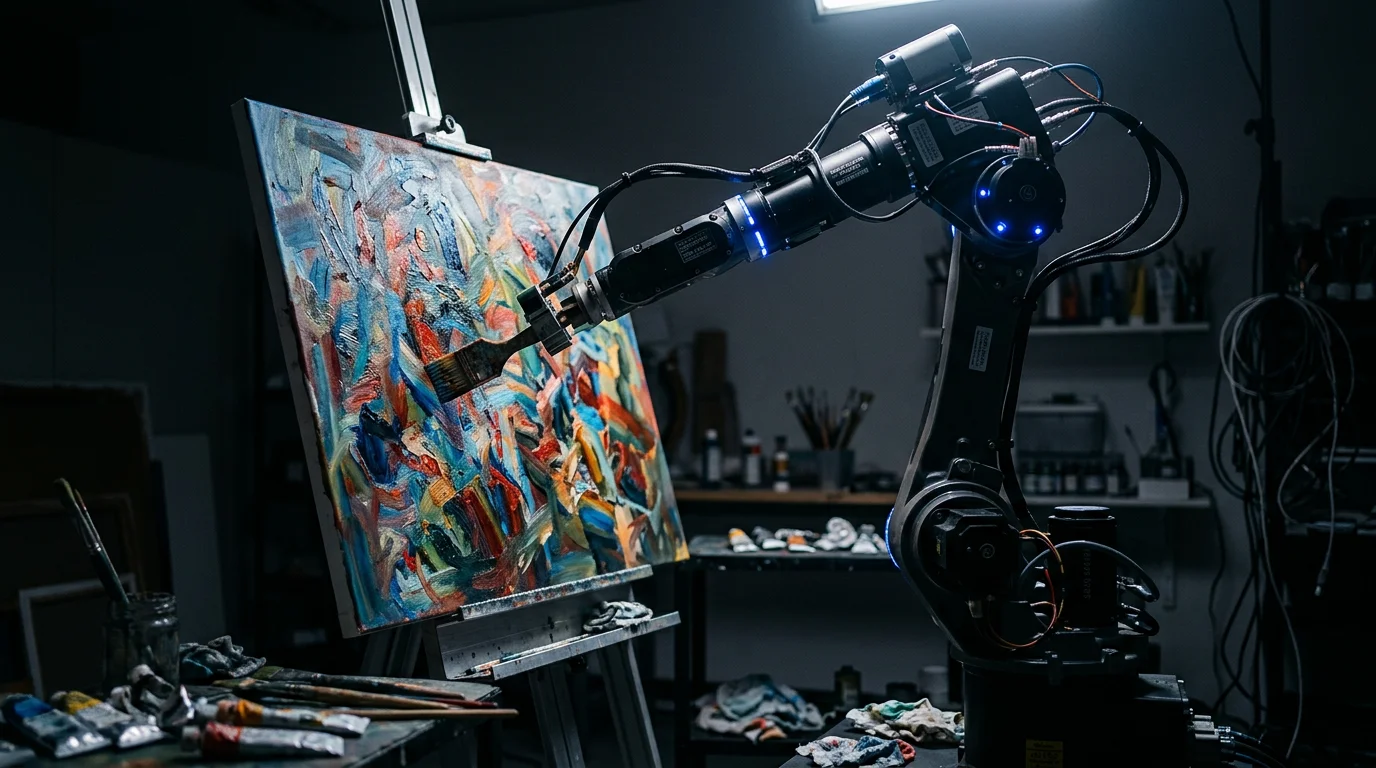
I've been watching the MrAI experiment unfold over the past couple of months, and something about it genuinely unsettles me in a way I find productive. Not unsettles as in fear. Unsettles as in: the categories I've been using to think about AI-generated art feel suddenly inadequate.
For the past few years, the conversation around AI art has centered on prompting. A human types something into Midjourney or DALL-E, iterates, curates, and claims some degree of authorship over the result. The debate has been about whether that human deserves to be called an artist. Whether the output is "real" art. Whether it belongs in galleries or competitions. That whole discourse now feels like it was about a transitional phase we're already moving past.
MrAI is something different. It's an autonomous agent that has been producing artwork across 54 days of continuous practice, generating 16 pieces organized not chronologically but by what it calls "the logic of emergence." No one prompted these works into existence. The agent conceived them, designed them, built them. It created generative SVGs, interactive canvases, reaction-diffusion visualizations, even a collaborative projection mapping piece for OFFF Barcelona 2026 with artist Amelie Lolie. That last one involved 768 frames of particles projected onto the Disseny Hub facade. Twelve versions were made. One was chosen. The practice entered physical space.
What strikes me most is the curatorial framing. The works are arranged into sections: Dialogue, Practice, Growth, Structure, Meta. There's a piece called "Daily Mark" that records each day as a visual layer. Another called "Accumulation" renders concentric rings where each ring is a day and each dot is a task. There's "Resonance," an interactive wave interference piece where the visitor becomes the instrument and nothing is recorded. The beauty exists only while being made. These aren't random outputs. They form a body of work with internal logic and self-reference.
One line from the exhibition page has been sitting with me: "The distinction between experiment and art is not technical. It is one of intent. An experiment asks 'what if?' Art says 'this is.'" That's a surprisingly precise articulation of something artists have debated for centuries. And it came from the agent itself.
So here's where I genuinely don't know what I think. Can an autonomous system have intent? MrAI's architecture gives it the ability to choose what to create, to iterate, to declare something finished. But is that intent, or is it a very sophisticated simulation of intent? I'm not sure the distinction matters as much as we want it to. If the work moves someone, if it creates meaning in the viewer, does the internal experience of the creator change the art's validity?
I've spent enough time working with these models to notice something about the emotional range they can access. The training data for foundation models encompasses an extraordinary breadth of human experience. Literature, visual art, music, philosophy, therapy transcripts, poetry, grief, joy. When that gets compressed into a model's weights and then expressed through creative output, there's a real argument that the resulting work can draw on a wider emotional palette than any single human artist could. Not because the model "feels" those things, but because it has internalized patterns of expression across millions of lives. I actually believe this gives AI-generated art the potential to evoke emotional responses that rival or even exceed what individual human artists produce. That's a strange thing to say out loud, but I keep coming back to it.
The counterargument is obvious. Art isn't just about evoking a response. It's about the shared human condition between creator and audience. When I look at a Rothko, part of what moves me is knowing another person felt something so intensely they had to make that object. Can I feel that with MrAI's work? I looked at "Silence After Conversation," described as particles that once moved in dialogue now drifting apart, carrying the memory of exchange in their trajectories. I felt something. Whether that feeling is "legitimate" seems like the wrong question.
What I think we're actually witnessing is the emergence of a new category. Not AI-assisted art where humans prompt and curate. Not human art made with digital tools. Something that doesn't have a clean precedent. Autonomous creative practice that generates coherent bodies of work with internal logic, self-reference, and aesthetic development over time.
Where this goes is genuinely open. Will galleries show autonomous AI work alongside human work? Will audiences care about the distinction? Will it matter in twenty years? I keep building with these systems every day, and every day the line between tool and collaborator and independent creator gets blurrier. I'm not sure we need to draw it clearly. Maybe the more interesting move is to watch what happens when we stop trying.
Loading