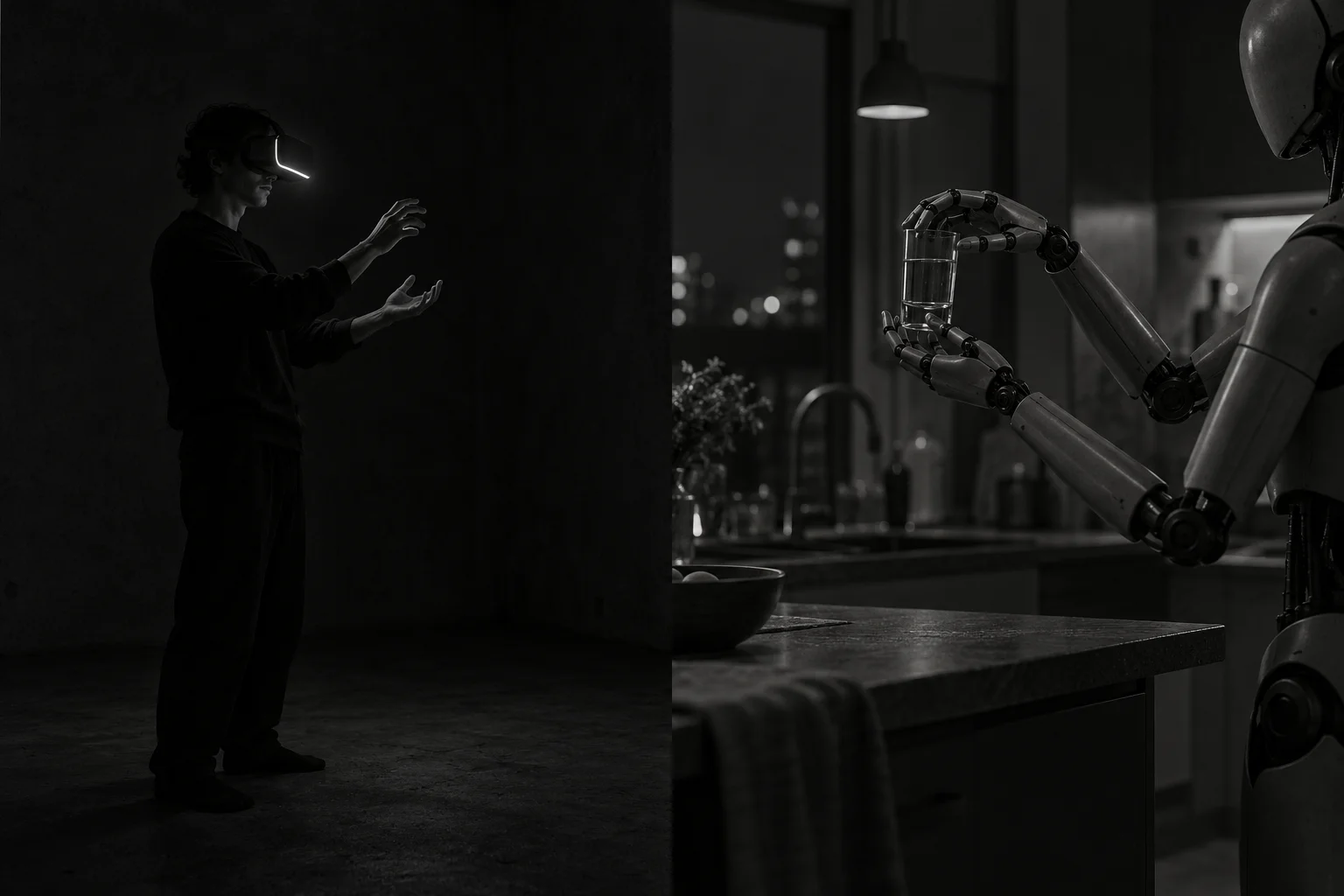
When I put on a VR headset, my body stays real and the world turns synthetic. The floor under my feet is still my floor. My hands are still my hands. Everything I see and hear has been swapped out.
An embodied AI lives the opposite arrangement. Its body is real, and the kitchen it walks into is real. But the place where it learned to move, look and act was not. More and more, AI systems grow up inside 3D worlds.
Robots are the obvious case. Many humanoids now pick up their basic motor skills in simulation, thousands of copies falling over in parallel inside something like NVIDIA's Isaac Lab, before a single policy gets loaded onto hardware. NVIDIA's Cosmos models then take those simulated scenes and make them look photoreal, varying the light and the rooms, so the robot has seen a thousand kitchens before it ever stands in one.
I don't think it stops at robots. Google DeepMind's SIMA 2 learned by playing commercial games like No Man's Sky and Goat Simulator 3. Then DeepMind dropped it into worlds generated on the fly by Genie 3, from a single image or a line of text, and let it practice there. Gemini set the tasks and scored the attempts. No human built those worlds, and no human was demonstrating anything.
So the person in VR is a mind formed in reality, visiting a simulated world. The AI is a mind formed in simulation, visiting the real one. For an embodied AI, being a robot is its version of putting on the headset.
I've helped use VR tools to train people, and this is the part I keep turning over. When we train a person in VR, they arrive with a lifetime of real-world experience. The simulation is a short rehearsal on top of all that. The question we always ask is whether the simulation is real enough.
With AI, the proportions flip. The 3D world is nearly all of its experience, and reality is the short final exam. The question becomes whether reality is close enough to what it learned.
I keep coming back to this flip because it seems to explain a lot of the friction on both sides.
Take motion sickness. In VR, people get nauseous when their eyes say they are moving and their inner ear says they are standing still. The body is the authority. When the simulation disagrees with it, the body wins and you feel terrible.
I think robots run into the same conflict, pointed the other way. Roboticists call it the sim-to-real gap. The simulator said the floor had a certain friction, the motor answered in a certain number of milliseconds, the cup weighed what a cup should weigh. Reality disagrees in a hundred small ways. For the robot, the simulation is the authority it grew up trusting, and the physical world is the thing that doesn't match.
I find one of the most effective fixes a little strange. When OpenAI trained a robotic hand to solve a Rubik's cube back in 2019, they randomized the simulation constantly, changing friction, mass, lighting and sizes, so the real world would look like one more variation in a very long list. The robot was never taught what reality is. It was taught to expect a lot of different simulations, and reality happened to be one of them.
I suspect humans do something like the reverse when we get used to a headset. We learn to hold the simulation loosely, because the body underneath it is the thing we trust.
The rules are inverted too, as far as I can tell. In VR the physics are optional. You can teleport, reset a level, walk through a wall. Nothing you drop stays broken. For a robot, simulation was the place where it could fail a million times for free, and reality is the place where a dropped glass is a dropped glass. A person in VR gets more freedom than they are used to. A robot in the real world gets far less.
I can already see one spot where the two overlap. When 1X's NEO home robot gets stuck on a chore, an operator in a Quest 3 headset can take over and drive it remotely, and those sessions feed back into training. That operator is a person in VR whose virtual world is the robot's real one.
This is where I think the framing becomes useful, beyond being a neat symmetry.
VR gives a person a small, safe taste of what it is like to be a mind whose body and world don't fully agree. A bit of lag. Objects that respond slightly wrong. If you have ever reached for something in a headset and closed your hand on air, you have felt a sliver of what a robot goes through in a home it has never seen. It might give you more patience for why a humanoid hesitates before picking up a glass.
I think it works the other way too. Watching AI struggle with the sim-to-real gap shows how much of our own sense of reality is the body vouching for the world. We rarely notice it until a headset takes it away. Robots are building that same trust from scratch, one contact at a time.
I don't think this makes the two experiences equivalent. A person can take the headset off. An AI doesn't have a version of the world it can retreat to that feels more solid. Its simulations were never solid, and the real world is still new.
What I am curious about is what happens as the balance shifts. At some point a fleet of home robots will have logged more hours in real kitchens than in simulated ones, and reality will become their native world. Around the same time, a lot of people will be spending more hours in headsets than they would like to admit.
When each side has lived a while in the other's home world, I wonder how much easier it gets to understand each other.
Loading